DREADBALL

DREADBALL
Showing posts with label Rules. Show all posts

July 8, 2013

Ultimate Dreadball sighting...

They posted a pic of the Ultimate (6 player) Dreadball pitch over on the Mantic site.  They took as they were playtesting the rules.  Looks like a blast!


Also Jake posted the Beta rules for the Teratons on his site.  They look interesting....That you can't slam them in the back is a pretty handy ability.
http://quirkworthy.files.wordpress.com/2013/07/teraton-team-beta-v1.pdf

Also Beta rules for the Nameless...
http://quirkworthy.files.wordpress.com/2013/07/nameless-team-beta-v1.pdf

Beta rules for Asterians...
http://quirkworthy.files.wordpress.com/2013/07/asterian-team-beta-v1.pdf

Finally Beta Zee rules...
http://quirkworthy.files.wordpress.com/2013/07/zee-team-beta-v1.pdf

Finally a pretty sweet Excel sheet that can track a team...
https://www.dropbox.com/s/rzlyusdplfl9m5p/KDM%20Dreadball%20Sheet.xlsm


March 4, 2013

MVP's and Friendly matches.


So here is a slight adjustment to the MVP rules for our league.  We actually have been kinda doing this from the start, just adding it in writing now.

We split the MVP's in to two Pools each week the League pool and the Friendly pool. We randomly determine which MVP's are available for league games each week, random between 2 and 7. They are the League MVP's and are bid on as according to the rules (League MVP pool). The MVP's are auctioned off and linked to that team for all games that week (League and friendly). Any MVP not bid upon in the auction is placed in the friendly pool. Their auction value is added to the team for Friendly games only.


Those MVP's not available for the "League" that week are in the Friendly pool. Friendly matches calculate their team ranking (adding in any league mvp's they may have) and determine underdog funds. The MVP's in the friendly pool may be taken with underdog funds. MVP's in the Friendly pool can take part in multiple friendly games during a given week. So the Friendly pool is there to help balance all friendly games..not just a first come first serve basis.  Potentially, there could be two friendly games happening at the same time, it is perfectly fine if both of those games have the same MVP playing from the friendly pool.


This could also add the potential of MVP's on both sides of the field...which is sure to make games even more interesting.


February 4, 2013

MVP's. Free Agents, Friendly Matches, and Post Match Revenues

Friendly Matches can throw a little bit of a wrench into things.  Things only get confusing when MVP's and Free Agents are involved.

Here is the situation, League night wraps up with the end of week events, the next weeks matches are selected, team rating s compared, MVP's and Free agents assigned.  Then we all go our separate ways for a month but the opportunity is out there for Friendly matches to happen.

Jake addressed the question in the FAQ...


Q: During a league, how should the Underdog rules interact with Friendlies?  If I’m reading correctly, the Underdog value is set based on the week’s schedule, that money is used to buy MVPs and/or Free Agents, and then you get on with the week.  It’s specifically mentioned that teams keep MVPs for any Friendlies they play during the week (pg 60), but that seems to remove the balancing mechanism since it’s no longer based on the teams that are actually playing.  Any advice for handling this?
A: As the rules stand, the MVP(s) involved do not modify the Team Ranking so they are effectively “invisible” to the balancing mechanism for friendly matches.
D: I noticed this after the book had gone to press. Most of our play-testing had focused on the match rules and league games, with little time for friendlies in between. This meant that this issue never arose. But you’re right, it could be unbalancing. 
What I would suggest is one of two options, depending on your style of play. On the one hand you could just let it ride as is. That’s what I’d do. In this case you take the in-game background view that it’s all just part of the rough and tumble of the game, and as you’re playing outside the strictures of the league proper (and it’s just to provide a fun and exciting spectacle for the fans) exact fairness is less important than making a good show and rolling out the famous names.
On the other hand, if you want a fairer friendly game, you could expand on the rules on page 53. My suggestion here would simply be to add the MVP’s cost to the Team Ranking when you worked out the underdog values before the match. Easy! Of course, you need to decide whether to use the amount they are nominally worth or the amount you paid for them (I’d suggest the latter as it scales to your league and the nominal values are quite cheap!).
*** So here is the official ruling on how we will handle Friendly matches in our league. ***
1) When you are setting up the Friendly match add in the value of the MVP (your bid price) and any Free Agents (10MC...not the players actual value) you may have to your Team Revenue.
2) Compare both Teams Team Revenue - apply all underdog rules except for the hiring of MVP's.  So the underdog may add a "Friendly Free Agent" and will gain an extra d6 revenue after the match for every 10MC they are shorthanded.
3) Occasionally a team will play their league game before the other teams get their league game of that week in.  The team that played their League match still gets use of their MVP and Free agents in any friendly matches for the rest of the month.  When they sign on the MVP they get them for the full month, not just the one league game.  The MVP leaves their roster only when the end of week processing happens and new available MVP's are chosen.


January 17, 2013

Team Painted League reward system.

I have been thinking of a gentle way to motivate folks to finish painting their teams, but nothing too over the top.

I came up with this simple solution for leagues.

If your entire team is three color Painted and Numbered, after each game your team earns and extra 1 MC.  I know not much, but after 10 games you could get another player.  Say the extra revenue comes from jersey sales from the impressive appearance of the team that game.  MVP's / free agents would not count toward the "Complete team" aspect and not be held against you.

Made a painting progress chart for the minis I have to paint.  Snap shot of it is to the right.

I've told Jeff from our league that I would paint his minis for him, so in the Bullpen League I will not take the 1MC award for my team until his team is completed as well.


https://docs.google.com/spreadsheet/ccc?key=0AiKPflpBkcQldENaSHI2amUzS1JNckktZ3hWOVpGX2c#gid=1


*** The Painting extra cash only applies to League games.  It does not apply to friendly matches between rounds.***

January 7, 2013

Random Monday morning thoughts...Edited

Couple of Random thoughts on a Monday morning.

Played a training game over the weekend with a good friend.  He made a suggestion that will send one of my Orx back to the greenstuff table.

My 4th Orx Guard and first add on to the team in a league, will be Piney.  Piney has some breathing issues and needed an Oxygen tank for much of the show.  So the Piney Orx will be getting a small oxygen tank and some translucent Fishing line running to his nose for the air tubes.

Second random thought is about The Ball scattering rule and the rush does not end until it stops scattering.  Though if an opposing player has a chance at the ball and fails, it can end their rush as well, (it does not end their rush).  This can lead to some confusion (even by me).  (Special thanks to FanofDreadball for the comment below)

Edit:  The confusion can be cleared up by the phrase "Lose the ball during your rush, your turn ends."  It is the potential "Free action" earned by doubing a scattered ball catch, and the timing of those free actions that can lead to confusion.

So here it my attempt to make the situation as confusing as possible and keep you all on board for the solution.

Corporation Player A has the ball, on rush 6 with 3 actions left.  He uses his 3rd action to attempt a pass to one of his strikers.  The striker manages to botch the catch and the ball scatters.  This starts the "rush is not over until the ball stops scattering" grey area.  

The ball scatters to Player B's Veer-myn Striker who manages to Double the inaccurate pass - scattered ball catch roll and gets an immediate free action.  This free action takes place now because technically the ball has not stopped.  Going through the end of turn sequence (Moving Ref, Sliding players down the sin bin) at this point is a little early as you will see.  So the Veer-myn player with his Free action declares a throw action with his Striker and runs down the pitch to get to a scoring hex, though in getting there he fails an Evade check and falls over...scattering the ball again.

The Ball scatters back to the Corporation striker for player A, who also doubles his Inaccurate Pass, bounding ball roll, getting a free action.   He takes his free action as a Run and moves up the pitch.  The Ball has now stopped "Scattering" from the first drop and it is still player A's 6th rush and he has 2 Action tokens left.
Now lets look at it the incorrect way...
If you had gone through the entire End of turn sequence once the Veer-myn striker had the ball, it could get even more confusing.  Say you did do the end of turn sequence before the free action, which would be understandable as the ball seems to have "Stopped" scattering.  It becomes Rush 7, the Veer-myn player does the free action before any of his Action tokens, and Evade falls with the scatter...losing his turn without using any of his 5 action tokens.  The ball scatters to the Corp Striker and another end of turn process starts, making it turn 8.

Can be a little tricky...hope I have helped some of you.

Guess the real point of this post.

"Free actions earned from a scattered ball catch are taken immediately and count as the ball still scattering."


January 3, 2013

Throwing the ball, Couple of rules clarified...


Pulled right from Jake's Dreadball FAQ.  Good stuff here, that I think helps the Rats (striker in the strike hex), and the Forge Fathers (Throwing at a downed target).
THROWING THE BALL 
Q: Can I have a friendly player on a Strike Hex when I Throw the ball at it? If so, what happens if the Strike attempt is missed? Can that player try to catch the ball (as an inaccurate Throw)?
A: Yes. A friend facing the wrong way will be struck as if he was an opponent. A friend facing the Thrower must make an attempt to catch the inaccurate Throw.
D: An intriguing conundrum here, and not explicitly covered in the rules. The ruling is based on the following logic. Firstly, you can choose to target the Strike Hex or an opposing player if they share the same space, so it would seem strange if you could not differentiate between friend and Strike Hex. So yes you can choose to either pass to your team mate or try for the points. In fact, you must make that choice as you can’t do both at once. And yes, there will be times when you do want to Throw the ball to your friend rather than at the Strike Hex.
If you score then all is well and the game continues as normal.
If you miss then an opponent would be struck. This should also apply to a friend who does not have the Throwing player in his front arc. He cannot see the ball coming to avoid it – even if he knows it’s on its way. 
If the ball misses the Strike Target and the friendly player on that hex is facing the Thrower then they must try to catch the ball (as an inaccurate Throw). This is the closest to the normal rule. Essentially you have to decide whether it should be more like a attack or a poor pass, and given that all DreadBall players have linked headset comms built into their helmets it seems reasonable to assume that a friendly player facing the right way will know what’s coming. 
I wouldn’t expect to see this happen much as it costs an action to get the player onto the Strike Hex on top of everything else and he only has a marginal chance to catch the ball. However, some folk are bound to try it  :)  
  
Q: Can I Throw the ball at an opposing player who is on the floor? If so, what modifiers (if any) apply?
A: Yes. The target cannot Dodge, and the normal modifiers apply to the Throw.
D: While it’s a bit mean and underhand to Throw the ball at fallen opponents, it also seems to be entirely in character with the game and I can’t see why you shouldn’t. The rules say that a target player only gets a chance to Dodge if they have the Throwing player in their front arc. As fallen players don’t have arcs they can’t possibly have the Thrower in their front and so cannot Dodge.  The modifiers and results apply as written with the obvious note that the target cannot fall over as they are already on the ground. They can however, be knocked back into other hexes by the force of the impact and can be required to make armour checks. As they are on the floor they have no facing so do not need to be turned if pushed back.

December 5, 2012

Order of events between League games.

Here is a rough draft of how we will handle the timing of things between games.

When the last game is finished for that round of games.

1) Each team will be awarded MC for the game (if they won any).

2) Award player skills for those that have gone up a rank, calculate the players new value to the team.

3) Each team will choose to recycle or regenerate players lost in the prior game.

4) Each team may buy new players, cards or coaching dice.

5) The team will calculate the teams new Total MC (Team ranking)

6) The team with the highest ranking must do steps 1 through 5 for The Charming Princes Corporation team  
  • Used only in weeks with an odd number of players 
  • Get help from the player that played them last.

7) The team with the lowest ranking chooses their opponent for the next round.
  • If two teams have the same ranking use the team with the worst won / loss record
  • If teams are still tied after won/loss record flip a coin.  

8) Progress upwards through the Team values until all players have an opponent for the next week.
  • If there are an odd number of teams then the remaining team will play against The Charming Princes Corporation team.  
  • The Charming Princes may not be selected as an opponent, they are only assigned to the last remaining owner.
9) Teams playing each other will compare their Team Rankings to determine the underdog money for the underdog if there is any.

10) Determine which MVP's are available. There will be a random number of MVP's available per round. 
  • The minimum number available will be 1 for every 4 teams.
  • The maximum will be at least 2 less than the total number of teams playing that session up to all nine being available if we have 11+ teams playing that week. Do not count the Charming Princes for this, as they will use a different set of MVP's.  
  • We will use a number of d3 or d4 rolls to determine how many MVP's are available that week.  
  • So say there are 8 teams playing...the min would be 2 MVP's the max would be 6, so 2d3 would be rolled.  
  • Once the number has been determined, randomize which of the 9 MVP's are available.
11) Auction off the MVP's that are available.
  • Randomly select one of the available MVP's
  • Team with the lowest Team ranking gets to make the first bid, and work your way up to the team with the highest Team Ranking.
  • Once a bid has worked all the way through every team without a higher bidder, the MVP is awarded to that bid.
  • Charming Princes may hire any MVP's from the pool of MVP's not up for auction to the rest of the league at the MVP's current hiring rate +1 MC.  This is done by the person who will be running the Princes in their game (Winner of the first game that has finished playing).
12) Teams with Underdog money remaining may hire Free Agents following the rules in the rulebook.

13) Play your next League game.        


Rules for Wildcard MVP posted.


With the early release for the Wildcard Mini...we get an early release of her rules as well!  Thanks Jake!
You can fund the rule at the following link.

http://quirkworthy.com/2012/12/05/wildcard/

This will bring the total MVP's for season 1 up to 9...though the Humans will have a little advantage as having the most available willing to play for them.

While we are on the topic may as well break down the list of which MVP's will play for which teams.

Corporation (6 total):  Lucky Logan, Wildcard, John Doe, Enforcer, Buzzcut, Number 88

Forge Fathers (5 total): Gorim Ironfist, John Doe, Enforcer, Buzzcut, Number 88

Veer Myn (5 total): Reek "Payback" Rolat, John Doe, Enforcer, Buzzcut, Number 88

Orx & Goblins (4 total): Slippery Joe, Enforcer, Buzzcut, Number 88

Remember just because they won't play for you does not mean you can't bid on them to keep them out of your opponents hands.

November 26, 2012

Odd number of teams on league night...

So here is my plan on how to handle an Odd number of teams showing up on a League night.

We will have a community team to be used only if there are an odd number of teams that show on league night.  This team will allow everyone to get their league games in.

The Team will be a Corporation team, and called "The Charming Princes" (displaced human team from my Orx team backstory).  I'll come up with some minis for them.

Here is how we will keep things fair.

1) League games are picked by using lowest team value.  The Princes may not be selected, they are assigned to the last team remaining   So as we are moving up the list and teams are chosen we will eventually get to a point with only 1 team is left...they will play against The Charming Princes.

2) The Charming Princes will be played by the owner of the team with the highest ranking, that finishes their league game first.  Use the rankings at the start of League night to determine.  That person chooses how the Princes will upgrade their team, buy new players / dice / cards.  (I'll run them if that person doesn't want to, just figured this would be the best way to keep League night rolling along.)

3) The Princes can also be the "guest players" team.  Meaning someone new shows up and they are not in the league, they can run the Princes if they would like to try out the game.  The Princes must still follow the rule below if being played by a guest player.

4) If the Charming Princes are underdogs, they may spend underdog credits on MVP's, just not the same batch of MVP's as the rest of the league that week.  They may only bid on MVP's that are not eligible to the rest of the league.  Meaning, when determine which MVP's are up for League auction that week, the rest are set aside.  These MVP's not up for auction may be hired by the Charming Princes at +1MC from their current salary.  This removes them from the auction, but still gives them a shot at MVP's if they are bigtime underdogs.

5) The Princes may also spend Underdog money on free agents if they wish.

That is all for now...

November 16, 2012

Dreadball Cheat Sheet

Found a very handy cheat sheet thanks to Roberto Clemente over at Boardgamegeek.com

 Direct link to look at this in a separate page over to the right.
 

November 8, 2012

Rough Draft: Maine League Season 1


Here is the rough draft for the Maine League, Season #1.

1) This is a living document so new ideas or adjustments may be made at any time. (EDIT..Edits will be prefaced with the EDIT tag.)

2) Still trying to lock down a date...Friday or Saturday nights.  Still trying to work out what is best for folks.  Every other weekend.  My place or the Greenhouse...working out the details.  May start at my place - taking the place of the monthly B-Tech game, then move to the G-House when Jeff's Pathfinder game is done.  (EDIT) Two leagues...once a month each.  Friday nights mid month, my place.  Saturday nights end of month. Greenhouse.

3) (EDIT) 5 Playing pitches, 2 boards, Acrylic one, Charming Field, and Madison Hex Garden.  Gregg's makes 6 for now.

4) (EDIT)  2 actual decks, printed out 3 more from the PDF I got for ordering Extra card decks.  Gregg's deck will come with his board if needed.

5) Proxy minis...will be allowed.  We are starting with 10 to 8 mini per team, and the 2nd sculpt shipment will not come in until "April".  As your team grows, you will need other minis to add on.  Likewise people will want to join in that will not have access to the Dreadball teams for a while.

6) MVP's - there will be a random number of MVP's available per round.  The minimum number available will be 1 for every 4 teams...the max will be at least 2 less than the total number of teams playing that session.  We will use a number of d3 or d4 rolls to  to determine how many MVP's are available that week.  So say there are 8 teams playing...the min would be 2 MVP's the max would be 6, so 2d3 would be rolled.  Once the number has been determined, randomize which of the 8 MVP's are available...and put them up for Bid.

7) Proxy for Buzzcut:  The Buzzcut MVP will not be included with the first shipment, So I have painted up a suitable alternative.  Fierce looking demon like mini...Could act like some uncommon alien creature that has the same stats as Buzzcut.  Will have to do until we get the actual mini.

8) The Wildcard mini will be shipped with this first shipment.  The Rules for Wildcard will not come out as a pdf sometime soon.  We will add her to the Season 1 pool of potential MVP's.

9) We will use Win / Loss percentage to determine the league winner.  If folks miss a week we will fall back to winning percentage, with a minimum number of games played to qualify. (EDIT) Must have played in 50% of league games to qualify your winning percentage.

10) "Friendlies" - Think of these as live scrimmages or  mid-season  practice games that count in every way except the won/loss record.  These can be played anywhere & anytime.  You will have any MVP or free agent you had from the last game you played of an official league night.  Only rule is you may not play the same person with friendly games back to back.  (EDIT) You may only play another player ONCE per month in a friendly match.

More to come...


October 23, 2012

Multiple Prone Markers...Tracking Idea


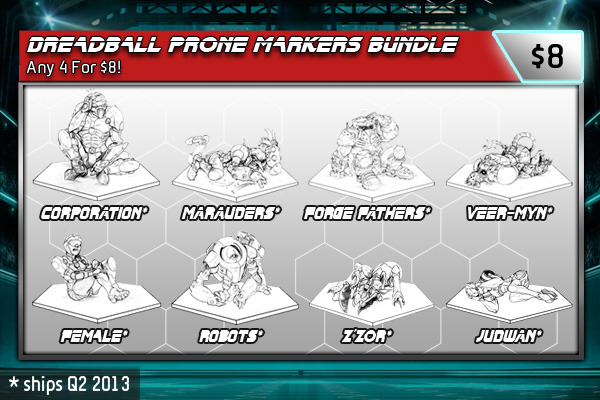
Played a test game, and at one point I had 4 guys down on the pitch.  Lacking prone markers we just laid our guys on the pitch.  The custom board I made has 30mm hexes, but with the 25mm hexes of the official boards I can see it getting crowded out there.  Laying them down will work just fine, unless there are 2 or 3 other models in the area.  The prone markers will be handy...though I can see it getting confusing with which player does which prone marker belong too.  So in expanding upon my Action tracking idea, I came up with this idea to help keep track of which prone player belongs to which marker.

Number your Prone Markers.  
When using prone marker #1, place the Mini you just took off the board next to the #1 of your scoring track on the edge of the board.  When using prone marker #2, place the player next to #2, Etc...

Example: Orx Guard #2 is knocked down, replace Orx mini with prone marker #1 and place Orx guard on the side of your board by the #1 of your scoring track. Goblin Jack #7 is knocked down, replace him with Prone marker #2 and place him by the #2 on your scoring track.

I can see players forgetting which player was prone in which hex when using prone markers.  I had players down for 4 or 5 rushes, because I was focusing on the ball and the players I had upright..  When the Judwan (All strikers) and Zee (all jacks) hit the board, I can see it getting even more confusing.  Using the scoring track will work because chances are you will not have more than 7 prone players from your team on the board (though I bet some Zee team will manage to do it eventually).

For those of you painting your prone markers, Number the bottom or make the jersey # be the prone marker number.

That's all for now folks...enjoy!

October 21, 2012

Stopgap rules for Fouls with Ref, and Warehouse closing

Fouls and the Ref, best guess rules to use until us Kickstarter folks get the PDF.


Pulled from "Lex Major" over on the Boardgame geek forums...Thanks Lex!


These are my idea of "stopgap rules" while waiting for the full ones (still 10 days to go at least!). These are "best guesses" on how to play fouls with appropriate rules. Feel free to suggest/comment.

FOUL ACTIONS
Fouls are called by the "victim" coach, and are rolled immediately after the Action is resolved.

Stomp: Is described in the rulebook preview on Mantic's blog. ( http://www.manticblog.com/?p=6362 )
Stall: Described at the same place.
Sucker punch: is a foul where you start in the target's front arc, and move to its rear arc before Slamming.
Sneak: is the foul where you put more players on the field than allowed. A random player is sent off.
Distracting the Ref: Choose a player within 3 hexes of the Ref, and have him spend an action. You can then Roll a d6 for distance and move the ref. Distracting the Ref IS a Foul, but only the player distracting can be sent off.

THE REF
At the end of their rush players roll a d6 and move the ref where they want. On a 6 you roll again and add to the initial score. The Ref starts on the checkered hex and can only be moved to legal locations (black hexes).

Spotting a Foul is a 1 Dice 4+ test when only the "Eye in the Sky" spots the foul. The number of successes will dictate the duration of the sin bin, with 4 being sent out for the match.
If the Ref is within 3 hexes of the Fouling player, there is +1 dice.

FAN CHECKS
Make a Fan check whenever a player:
- Sends another player out of the game.
- Scores a 4-points Strike!
- (there must be something about passes, etc, but can't think of it).

Roll 3 dice at 4+, and get the number of successes as a "Cheer" token. When you have 3 Cheer tokens, you gain a Coaching Dice.

EXTRA MOVE, SPECIAL CARDS, ETC.


Are not used.


Kickstarter When?

Also Mantic is closing their Warehouse in Mid-November to (I would guess) put together the Kickstarter packages for shipping.  So I would guess a first week of December arrival time here in the States.

Best guess for the PDF of season 1 rulebook is soon after they close up the Kickstarter Survey...so maybe a Happy Halloween Treat.  


October 15, 2012

Tracking Actions taken by players.


  Each player is limited to Two Actions Tokens and One Card per Rush.  With the free actions it can be a little confusing as to which player had used which action.  Add in the fact you can use an Action token on a player, move on to use actions on other players then go back to the first player you used an action with.  I know...how hard is it to keep track of 5 actions?  Well things happen, folks get distracted, and us older gamers don't have the memory we used to.  If nothing else this will be a tool to help when learning the game.

  Here is the idea to help you track which players had actions played upon them.

When you play an action on a player, place the action counter along side the turn track that matches that players number.

  For example:  My rush starts and I want to do a Run action with Goblin Jack #7.  I place my action token next to Turn 7 on the turn tracker along side the board.  My 2nd action, I want to Slam with my Orx Guard #3...I place the action token next to Turn 3.  My 3rd action I want to move Goblin Jack #7 again, so I place that token next to Turn 7.  The two tokens next to that turn show I can not play any more actions on player #7.  At the end my my turn I would pick up my action tokens.  You could also put the used cards in a turn over by the turn tracker I as well.

  I know that gamer attention spans are not the greatest in the world.  Or you may have to walk away from the game for a bit.  Heck this may be in the rulebook already.  Or attempting to use more than 2 action tokens on the same player my be a "Foul" only if you are caught...not sure.  Wanted to throw this idea out there as it seemed a simple means to keep track of which player had gone.

Edit:  Jake (the Dreadball designer) visited the blog!  He clarified that using more that the 2 allotted actions on a given player is not a "foul", doing so is just against the game rules and may not be done.     

September 27, 2012

Tid bits for the League...

Hey Guys...

  Couple of odds and ends.

1) Looks like the kickstarter will hit the $500k mark.  That will unlock a Megahex sized mini. There is one being made for each of the starting 4 teams.  Each Striker package will get to choose one of those minis to be added to their package (sometime in June I'm guessing).  With the cheerleader package we will end up with two of them.  How to divy them out is the question.  They will only be used in "Ultimate Dreadball" games on a new Mega gameboard...where 4 teams can play at once.  Open to suggestions on how to divvy these out...put them in the Draft pool, at the cost of 2 rounds worth of picks?  Award them to the top two League finishers of our first season?  Random?


2) EDIT-Called "The Nameless"-  Based off the "John Doe" MVP.  Will be unlocked if they hit $515,000.  Will add 2 to each Striker set (4 for us) and add them to the Buy one Get one free 2 teams for $25 deal.


3) Coaches:  Rumor has it the Coach is used to gain extra "Coaching Dice".  The "Call the play" by putting the coach on the game track saying how many points you will score.  If you do score that amount, you get another coaching die.  So there is a use for any duplicate MVP mini you end up with that doesn't quite fit the team.


4) Cheerleaders:  Cheerleaders work in a similar way as coaches.  You place the Cheerleaders along the scoring track before the game starts.  If the game score lands on one of the spaces with your cheerleader that gets you a Fan check.  The Fancheck generates fan points which convert into coaching dice (4 points = 1 die I think).  So cheerleaders could be useful as well.


Lots of other ideas running through my head...but those can wait.


September 21, 2012

Dreadball FAQ

DreadBall FAQ

How long does a game of DreadBall take?
During playtesting, most games ended up between 45 and 75 minutes, with the occasional bloodbath going on a bit longer!The game works on a "differential scoring" system - it starts at 0, and moves towards the scoring team whenever a Strike happens. So, for instance, if the score is one point in my favour, and you score three, the the score will be two points in your favour. Get it? After 14 turns, if the score is 0, Sudden Death starts, and things get interesting. The gates slam shut (so no Reserves can enter play), and the first team to score a point - or the last team standing - is declared the winner!


How do cards come into play?
The cards are multi-use - they each contain four different pieces of information:

- They've got an in-game effect
- They've got a list of numbers that's used for random player selection
- They generate a random number for Ref movement
- They've got a "Cheer" rating, used in Fan Checks.

In-game effects are the main part of each card. These are Actions or Events. Actions cards can be used to supplement your five action tokens for a turn, letting your team do that little bit more, or pull off a complex play even when the dice don't behave themselves. Event cards are generally remains-in-play effects, lasting until another Event is played or drawn. They change the game in small ways - maybe the ball bounces more randomly, maybe one of the players was partying too much last night, or maybe the Ref is feeling particularly short-sighted.

You can spend an action in-game to buy a card and keep it in your hand, ready to be played later, meaning you can lose an action in the short term to gain something useful in the long term. Most teams also start with a number of cards in-hand.

Sometimes, cards are drawn randomly - for example, when the Ref has to move, when a random player needs to be selected, or when a Fan Check is made due to a player scoring a high number of points or landing a real bone-crunching hit. When this happens, and the random card is an Event, it comes into play immediately - this can cause sudden, subtle changes in the flow of the game at key moments.


How is the ball moved around the arena?
The ball is carried by players, but it can be lost fairly easily, so it's best to keep a ball carrier away from enemy players. The ball can be thrown, but the throw distance isn't massive, so tactical movement is encouraged. The game features a core "facing" mechanic (i.e. the way your models are facing matters!), and this comes into play with passing - it's a heck of a lot easier to pass to a player who's looking in the right direction...

Of course, if the ball's dropped, it starts rolling around the pitch. The direction of travel is randomly determined with a dice roll - the hex system is very handy for this - and loose balls travel a number of hexes equal to a dice roll. This can take it quite a long way, and if it hits a wall, it bounces off.


How likely is it that a player will be killed during a game?
Deaths happen in almost every game; however, with the advanced medical technology held by the DGB (The DreadBall Governing Body, a.k.a "Digby"), it's not as much of an inconvenience as you might expect! If a player is killed in the arena, the team's coach has the option of paying a fairly hefty medical bill to have him revived, or recycling his vitals through approved DonorVend sites, making a bit of money back in the process.


How does player advancement work?
Players gain experience during games by doing the sort of thing the fans love - scoring lots of points, really hurting enemy players, or just being generally useful. When players level up, they can gain a random skill or stat advance from a list depending on their player type. Players advance fairly quickly at the start of a season, but this levels out as they become more grizzled.


How do the teams differ from each other?
Sticking to the four Season One teams, here's a brief summary:

The Corporation team is the most generic all-rounder, although it does fare slightly better when going for passing / Striking plays that it tries brute force - especially when playing against the heavier teams! The starting composition is three Strikers, two Guards and three Jacks. The best tactics I've seen involving Corporation teams feature lots of free actions, chaining up passes between Strikers to move the ball past the defence and into a position to make a three or four point Strike.

Marauders, on the other hand, are just plain brutal! Orx are the hardest hitters in the game. They've got a statline that's all about dishing out violence, and as Guards they get bonuses to dice tests for Slams and Armour Checks. Goblins, on the other hand, are fairly good at dodging, and average at picking up the ball, but not great at hitting opposing players! It's a team of two halves (staring line up is 3 Orc Guards and 5 Goblin Jacks) and you need to play it as such. Success generally means taking opposing Strikers (and other threatening players) out of play as early and as frequently as possible, giving the Goblins a chance to score Strikes where they can.

Forgefathers might seem a bit like a short, bearded Corporation team at first - they're the only other team (so far!) to have all three playing positions. However, the way they use them is quite different! Forgefather teams aren't very fast, but they make up for that by being characteristically fierce and uncompromising! Their Jacks can hit almost as hard as an Orc, and their Guards are terrifying brutes who simply refuse to be knocked down. The presence of Strikers on the team makes a passing play viable, which some playtesters were surprised (and delighted!) by. Starting line-up is three Guards, two Strikers and three Jacks. The team adapts well to different tactics, but is particularly good at making its way up the arena, bowling enemy players aside, and letting a Striker make a high-scoring Strike.

Veermyn are, in my mind, the oddball team. They're the one that's got amazing potential, but is most challenging for a new player to use. They've also got the strangest line-up. See, Veermyn don't make natural DreadBall players - so they have to compensate! As a result, every player who isn't massive enough to be a Guard is trained as a Striker. This, when added to their natural speed and agility, makes the team a frightening prospect in the hands of a skilled coach, even if their lack of immediate flexibility makes them a challenge straight off the bat. They can dash around defenders like they're not there, they can Sprint from one end of the arena to the other in the space of a turn, and it's near impossible to knock them down and make sure they stay down. Unfortunately, their achilles heel is their low level of ball skill - you can't guarantee they'll always pick it up, let alone be able to score! The starting lineup is 2 Guards and 6 Strikers. Tactically, it's best to aim for multiple low-point Strikes - you're after quality, not quantity! Also, use spare Strikers to help your Guards when it comes to Slamming enemy players - as you've only got two players who can dish out damage, you want to make sure they've got the best chance possible of doing something!

Each race has its own profile, meaning they all feel different, with their own strengths and weaknesses. Each player is ranked in Movement (how far they can move, funnily enough!), Strength (how good they are at hitting people), Speed (reflexes, agility, etc.), Skill (with the ball), and Armour (i.e. how much of it they're wearing!). Armour is dependent on player class rather than race, with Strikers getting the least protection and Guards getting the most.


Why don't Veer-myn teams have Jacks? Is there a plan to release them later?
As it stands, as far as I'm aware, there's no plan to release Veermyn Jacks - it's a characteristic of the team that they don't get them, and something that makes them stand out. In fact, the option of having Jacks would massively overpower the team, as it would greatly add to their flexibility. Similarly, don't expect to see any Orx who aren't guards, or Goblins who aren't Jacks - with one notable, moustache-twirling exception - for the same reason.

That said, there's nothing saying that future releases and expansions won't address these things. I'm just talking about the game as it currently stands!


How do the various player positions act in the arena?
Strikers and Guards are opposite ends of the DreadBall spectrum. Strikers get bonus dice for tests involving handling the ball and being agile, but they have weak armour and don't have the ability to make attack actions (or reactions). They also get the bonus ability that whenever they take a Throw action, they get a free Run action (normally, a Throw action lets you make a one-hex move before throwing).

Guards are just the opposite - they have bonus dice on armour checks and Slams (your main offensive action), and they get a free Run action as part of a Slam (again, a Slam normally involves only one hex of movement). However, as Guard armour doesn't feature a DreadBall Glove (the attachment that lets players handle the ball without getting their arm ripped off!), they don't have the ability to pick up or handle the ball in any way.

Jacks - short for "Jack of all trades" - are the middle ground. They have access to all actions (including Throws, so yes, they can score too!) but they don't get any particular bonuses. Ask any Jack, and he'll tell you that he's the most useful person in the arena, and also the most underrated! Jacks are cherished for their flexibility and the fact that they can step up to any task - with a bit of luck, there's nothing they can't do!

There's also a secret fourth player position - the Keeper! Starting teams don't get Keepers, as it's an experienced-based upgrade for a Guard. Keepers get even heavier armour (a Keeper's armour stat is 3+ rather than 4+, and he still gets a bonus dice as he's a Guard) and a DreadBall glove - meaning he has a limited ability to handle the ball! He can't make a normal Throw action, but he can Punt it by placing it anywhere in the arena and scattering it twice. This means Keepers make great defensive players - they can batter incoming ball carriers, grab the ball, then fling it up the pitch. Okay, a Punt ends your rush (because you lost the ball), but it's better than having it sitting right next to one of your Strike zones!


How many skills are there to choose from?
There are 14 skills (called abilities in DB) in the initial set. This might not sound like a lot, but remember that each of the 3 player roles can already do different things, so the abilities build on three varying starting points. In addition, because each player type starts from a different place and does something different in play, the extra abilities vary in utility from role to role (and race to race).

Some abilities are limited by player role. In DreadBall nothing is limited by race, always by role. So, if a human Striker can do something then a Veer-myn can try his paw at the same thing. Of course, as they have different racial stats then their chances of success will probably be different too. Having said that, not all races have access to all roles, so in that way there is a racial limitation. I haven't checked to see whether that means that a specific ability is unavailable to a given team.

The available abilities are called:

A Safe Pair of Hands
Backflip
Can't Feel a Thing
Does This Hurt?
Gotcha
Grizzled
Jump
Keeper
Lucky
Mind Like Water
Really Lucky
Roll
Running Interference
Steady


Are there coaching staff upgrades and team re-rolls?
Coaching staff upgrades are slated for Season 2. The equivalent to Team Re-rolls in DB is Coaching Dice, which have a broadly similar effect. However, in DB you can earn them during the match as well as spending those you start with.


Does failing a roll end your Rush, or will a team always get to complete its five actions if they don't drop the ball?
Rushes don't end when you fail unless you drop the ball, so you can go in, fluff something completely and then still carry on, as long as you didn't drop the ball. Of course, you can end your own turn voluntarily if you choose and you could have so few models left standing that you ran out of people to act with before you ran out of actions, but these are both very rare events and are included mainly for completeness. In most Rushes a Coach will get to use all of his team actions.


Are there injuries that stick with a player in a league format?
No, we don't have injuries. Although it can be characterful, it is something that many people don't like in BB (though others think it's great). DreadBall was intended to be slightly more streamlined than BB and this was one of the details I deliberately left out - no point in replicating something that people moan about, is there? Of course, you can get dead, which does affect you quite severely in future games.


What does the Ref model do?
There are various fouls in the game, and your opponent has to call them. However, just because the Coach has spotted them doesn't mean the ref has.

There are actually two referees in the arena - one is a floating "Eye in the Sky" that hovers over the pitch and can potentially see anything. This is not a model. The Referee you get a model for is the on-pitch ref. She moves about the pitch, controlled by both players in turn.

When a foul is called by a Coach, you roll to see whether the perpetrator has been spotted by the ref(s) and if so how long they are sent off for. You always roll one dice for the "Eye", but you only roll a dice for the on-pitch referee if she is close enough to the perp when he makes the foul.

So, moving the ref is tactical. You can use them to get in your opponent's way by blocking a hex, to get out of the way of your own players as they commit fouls, or move them up to try and spot likely fouls by your opponent. Moving a ref is a free action in addition to your Team Actions.

How many players can a team have in play?
It's 6 on the pitch at any time; starting teams (eight players) then get two in reserve. Of course, unscrupulous players can sneak more than six on... but if the opposing coach spots it, there's a good chance a random player will be sent off!


How many players can you have on your roster, and are there limitations on positions?
The composition is quite flexible. Teams start out as a fixed 8 model squad. The limit is a total of 14 players. This limit can be made up of any combination of roles with the single proviso that you cannot have more than double the number that you started with of a give role. So, a human team starts with:

2x Guard (max = 4)
3x Jack (max = 6)
3x Striker (max = 6)

The most it can have of each is double, but because this is more than 14 in total you have some flexibility. Also, Free Agents and MVPs don't count towards this total of a player type, but do fill slots of the 14, so if you have left a slot or two for them then you've got more variety to your composition.


How does tackling work?
Tackling is represented in two ways. Firstly, Guards and Jacks Slam opponents to try to knock them over (as an action), which is represented by an opposed test (your opponent can dodge, or "Slamback" if they're not a Striker and the slam didn't come from behind). Secondly, all players have a "threat zone" - the three hexes in their front arc - and enemy players have a negative modifier when taking actions if they're standing in one of those hexes. Also, if they try to move away, there's a chance they'll get tackled and fall over.


Are all players worth the same amount, and can you create your own teams?
Players have different values - a human Jack doesn't cost the same as a human Guard, and a human Guard doesn't cost the same as an Orc one. Each starting team has a set number of players, and as Jake said, the maximum you can have of each position is twice the starting number. (Yes, a Veermyn team can have twelve Strikers. The horror...) Incidentally, did you know that as well as leagues and basic, out-of-the-box games, there are rules for Exhibitions? You both pick a budget, create teams from scratch (buying experience and MVPs), and have a one-off riot! It's a fun way to get some extra character involved, and to try out some of the more advanced rules, without having a full-blown league.


How does the game play single-game vs. a campaign/season? Would it play well as a series of multiple games between two people?
 in order to make the game fun at all levels, it was designed to work as a aone off game without the cards. This means that the core is solid and fun (as it has to be) and that the cards and the league system build on that. I've played loads of one-off games, often several against a single opponent in an evening. We had fun!

Leagues are different rather than better or worse. I think that's true of other games with similar systems. I enjoy the added story elements they bring, but they are more effort all round.


Can you intercept a ball that's thrown by an enemy player?
Interceptions were considered in the very early stages of the game, but ultimately discarded as they never, ever happened due to the nature of the game. If a player was in your way, it was really easy to take a step to the left or right and throw. This, coupled with the fact that it wasn't entirely easy to explain when a player counted as "in the way", consigned interceptions to the cutting room floor. I think I can safely say no one's missed them!


How do fans work, and is there a home field advantage?
Fans are represented by the game cards. Whenever a player does something cool - a high score, a big KO, etc - you draw a card and check its Cheer rating (Generally between 0 and 2). If there's at least one Cheer, you store it under your Fans card; once you get three Cheers under your card, you trade them in for a bonus Coaching Die. (These are dice that you get a certain number of at the start of the game, depending on your team, and which you can add to important dice rolls to make sure you succeed.

There's no advantage for home fans, but certain cards do indeed have events that represent the crowd singling out a certain player!


Is it only Strikers that can Strike?
Nope – Jacks can also make Strikes, they're just not as good at it. Guards can't handle the ball at all, unless they take the Keeper upgrade.


Can you win by wiping out the opposition?
It is technically possible, though I've never seen it done. The Landslide victory rule which means that one side wins automatically if they get a 7 point lead has tended to stop games before the wipeouts happen. In DreadBall it is quite hard to retain possession of the ball, so people tend to try and score Strikes as soon as they can. Holding onto the ball in order to pummel the opposition is asking for them to take it off you.


The four teams that are available are all named. Is it possible to design your own teams?
The best way of thinking of the teams we've listed is as the archetypes for their races. So if you want to do a Corporation team, use the Trontek 29ers stats. This isn't their stats at the height of their fame and power, it's their stats when they started out as a rookie team and were much like every other rookie team of their type. Same goes for the others.


Can a player stand in the strike hex to block opposing players from scoring? Especially a big hulking guard/keeper?
This came up a few times in playtesting and we tried it both ways round. In the end we decided that you could not block a Strike Hex.

On most pitches the Strike Target is actually a hologram which appears just as someone enters the Strike Zone carrying the ball (ie become eligible to score). As the target is a holographic projection, measuring whether a throw has been aStrike or not is done by computer tracking of the ball's trajectory. This means that standing on the Strike hex won't make any difference as the computer will simply calculate the Strike whether it hits the player or not.


How easy is it to win in two turns with a seven-point Landslide victory?
Very hard. It has probably been done, but I haven't seen it myself.


Do adjacent opponents give negative modifiers to checks when throwing the ball, etc.?
Depending on facing, possibly. In general, standing in the Threat Hexes of an opposing player gives you a -1 dice penalty per player to a max of -2. That's when the action is not in opposition to that specific player. So, if I Slam you we roll an opposed roll, so I ignore your Threat hex. But if I Throw the ball when I am standing in your Threat Hex then it's at -1 dice.


Can the same MVP be hired by more than one team?
I won't go into too much detail here, as Jake's done a couple of blog posts on it, but there's a clever bit of jiggery-pokery in the extended rules where each MVP can only be hired by one team. The same mechanic increases the cost of popular MVPs throughout the season, while dropping the cost of less popular ones - meaning a season has its own model economy!


What ends your Rush?
The only ways your rush can end are when you lose the ball (or fail to pick it up) when you run out of actions, or when you run out of players who can take actions. As such, it's fairly rare for your turn to end when you haven't got possession of the ball!

Even a successful Strike brings your rush to an end, as you've (intentionally) lost the ball - one of the mistakes new players make is going for a Strike with the first action of a rush! Unless something particularly oddball happens, attempting a Strike is going to end your rush, one way or another.


What happens if you miss a Strike?
If you miss the shot then you have lost the ball - it will scatter and your Rush will be over, as stated above.


Does the Rush ending whenever you lose the ball affect the game's fluidity?
Once you get your head around it (usually by the end of your first game, going by playtests) it doesn't disrupt the flow of the game at all - in fact, it makes for some really tense moments! You've got the perfect strategy planned, all your actions lined up for the turn, and all you need to do is pick up the ball or it's all over... Surely rolling at least one 4+ on three dice can't be that hard, right...?


What's in the rulebook?
The rulebook is split into 4 sections. The first bit covers background, intro, example Rush and listing all the components and what the different bits mean, etc. Then there is the rules section, which is about 25 pages long. After that there is a section on league play, running leagues, experience for players, and so on. Finally there is a reference section with the team and MVP stats in.

There are no advanced or optional rules other than playing leagues, which is a style of play and a time commitment rather than a variant.


How many Strikes are scored on average in a game?
Most games probably see an average of a Strike every 2 Rushes, and it is perfectly possible to score in a single Rush.


Are the cards language-dependent?
About half of the cards are fairly language-dependent, I'm afraid - the other half are easier, as they're mainly "Free action for a Striker" type cards. The first half, though, tend to have a title, a short narrative explanation, and an in-game rules effect; if you've played games like Last Night on Earth, Arkham Horror, or that sort of thing you'll know what I mean.

However, the good news is that the game will be translated into at least three other languages.


Is there a limit on the number of MVPs a team can hire? Could you theoretically play an all MVP team?
Technically, there's no limit - you can hire as many as you can afford! Also I love the idea of two all-star teams; there's no reason why this wouldn't work.


Is there an equalising mechanic so that new teams can play experienced ones?
 Each team has a value, which increases as players gain experience or are added to the roster. Before playing a game, you work out the difference between the two teams, and the team with the lower value gets a stash of megacredits (the in-game currency) to bid for MVPs, or to trade in for one or more rolls on the Free Agent table. These can be players from any of the core teams - for example, if you're particularly lucky, your Veer-myn team could end up with an Orc Guard to pad out the ranks! This might seem a bit crazy at first, but the idea is that it gives underpowered teams the chance to pull out something special when they'd otherwise be almost certainly flattened.


Which hexes in the Strike Zones can you try to score from?
You can make an attempt from anywhere in the strike zone. The bonus hex (the one furthest from the strike hex) gives you an extra point but is harder to achieve (you suffer -1 dice, on top of the normal -1 for attempting a Strike.)


What are the upper and lower limits for stats?
Currently, a game value can never be increased to better than 3+ with character advancement, and there are no 6+ values, but that's not to say such things won't happen in the expansions!


What does the “Sucker Punch” foul do?
A Sucker Punch is any Slam action during which you start in front of your target, then move behind him before making the attack. This has the in-game effect that your enemy can only choose to dodge rather than slamming you back, meaning that this is a great tactic for taking down enemy Guards. (...or most Forgefather players!) Of course, due to the fact that this is fairly easy to exploit and hardly fair play, it's counted as a foul!


How can the ball end up in a hex with a player?
This can happen in one of two ways:

First, players don't reset after a Strike. This means that there's a fair chance of a player standing in the centre of the arena and being in a position to have the ball land at his feet! Second, the ball could travel six hexes then rebound off the far wall, flying into either end of the arena where it could come into contact with any player.

Of course, in most cases the ball will scatter away, but if the player's a Striker - or wants to use a Coaching dice, as I rather cheekily did in a game yesterday! - they've got a chance of making a catch. (And if they manage to do really well on that catch roll, they could get a free action, which they could use to score in the enemy player's turn, if they're feeling really jammy!)


If you want to free up space in the arena to move in a player from the Subs' Bench, can you move a player out of the arena?
Yes – you move the player off through the gate to the subs' bench area.


If you Slam a ball carrier, do they lose it if they get pushed back, or only if they get knocked down?
They only lose the ball on a double, i.e. when you knock them down. Those gloves are pretty good at holding onto a ball when the wearer's getting shoved about a bit!


If the ball is launched into the arena at the start of the visiting team's turn, and the home team's Striker is in a position to catch it, what happens if he manages to do so?
As the visiting team haven't lost the ball (in fact, they never had it, or even attempted to pick it up!), their rush doesn't end. They get to act as normal, and I imagine their first port of call will be Slamming seven shades of nasty out of that Striker. However, if the Striker got lucky and rolled some sixes, he might have doubled the catch roll - which grants him a free Run or Throw action, which he immediately gets, even though it's not his turn!


Can you stand on your opponent's gate hex and block their reserves from coming on from the Subs' Bench?
Yes – this is a foul, though, called Stalling. If your player is caught doing it there's a fair chance he'll be sent off... and the Ref check is made every time any player on your team takes an action, not just when that player does.

September 20, 2012

Glossary of Dreadball Terms

Pulled from the game developers page...might be helpful to get into the jargon

Action: A Rush comprises a number of Actions. Each Action allows a single Player to perform a discrete task such as Slam an opponent or Throw the ball.  

Coach: the real world human playing the board game.  

Doubling: when the total number of successes in a roll is equal to twice the Target Number or more. Often triggers an additional effect.  

Free Action: an Action that does not cost a Team Action Token or a Special Move Card. usually earned by Doubling a Target Number.

 Guard: a type of Player. Guards are heavily armoured are are the most survivable. Their job is to make a hole in the opponent’s line and to protect their own Strikers. They cannot pick up the ball.

Jack: a type of Player. Jacks can try their hands at anything.  

Player: one of the imaginary individuals that make up a DreadBall team, represented by a model in the game. Players come in 3 types: Strikers, Jacks and Guards.  

Rush: a turn. Within a Rush a Coach is able to make a number of Actions. The game lasts for 14 Rushes, 7 for each Coach.  

Skill: a Stat. How good at throwing, catching and general ball handling skills a Player is.  

Slam: A type of Action in which a Player tries to knock an opponent down.  

Special Move Card: a type of DreadBall card. Each one defines a specific type of Action(s) that a specific type of Player(s) can perform by spending the card instead of a Team Action Token.  

Speed: a Stat. How agile and dodgy a Player is.  

Stat: short for statistic. This is one of the game values that defines a Player. There are 3 main stats: Strength, Speed and Skill.  

Strength: a Stat. How strong and fighty a Player is.

 Strike: the name for scoring in DreadBall. Used similarly to the term in bowling.  

Strike Hex: one of the target hexes that you must hit in order to score.  

Strike Zone: the area of the pitch in which you must be standing in order to make a legal Strike. In higher tech arenas the Strike Hex is often a holographic target and will only appear when a Player is in a position to legally score.  

Striker: a type of Player. Strikers are lightly armoured and are the best at handling the ball. Their job is to make Strikes. They cannot Slam opponents.  

Success: a result on a single dice that equals or exceeds the Stat against which the roll is being made.  

Target Number: the number of Successes required in a dice roll to perform the Action.

 Team Action Token: one of the 5 tokens that a Coach gets each Rush to activate his Players with.

Threat Hex: the three hexes immediately in front and adjacent to a Player. Opposing Players standing in a Threat Hex are penalised for some dice rolls.  

Throw: a type of Action in which a Player attempts to launch the ball either to a teammate, at a Strike Hex in order to score a Strike, or at an opponent in order to injure them.